
Dental Implants for McLean, VA Patients
McLean, VA patients trust prosthodontist Dr. Gerald Marlin for dental implants. 4,100+ implants placed with advanced planning and precision techniques.
You need a dental implant. Maybe a tooth fractured and couldn’t be restored. Maybe you lost a tooth years ago and now regret not addressing it. Maybe several teeth are failing and you’re considering your options. Whatever brought you to this decision, understanding what actually happens at each appointment helps you prepare mentally and logistically. Here’s the reality of implant treatment from your perspective.
Considering Implant Treatment From McLean? Understand the Visits, Temporary Teeth and Follow-Up Before You Decide
Implant treatment is a sequence of visits with healing intervals between them, and a patient traveling from McLean should know the number of visits, what temporary teeth will be worn between them, and how follow-up is handled before deciding where to be treated. This page explains that sequence as it runs at Elite Prosthetic Dentistry, where placement and restoration are planned together and performed in the practice with the laboratory on site. Our office is in Friendship Heights, Washington, DC, at 4400 Jenifer Street NW, one block from the Friendship Heights Metro, with parking in the building. From McLean the usual route is Chain Bridge Road and Arizona Avenue, without the Beltway; allow for traffic at your appointment time.
Your Initial Consultation: The Foundation for Everything
You arrive for your first appointment uncertain about what to expect. You’ve researched implants online, read conflicting information, and have questions you haven’t fully articulated. The initial consultation is where we answer those questions and establish a realistic foundation for treatment.
During this appointment, we review your medical and dental history comprehensively. We examine your mouth carefully, noting bone volume, adjacent tooth structure, and any existing conditions affecting implant candidacy. We take three-dimensional imaging allowing us to visualize your jawbone in exceptional detail, revealing bone width, height, and density in areas where your implant would be positioned.
Dr. Marlin explains findings in clear language. He shows you imaging, pointing out bone quality and location where your implant will be placed. He explains how implants work, how long treatment takes, and what the financial investment includes. He answers every question directly. No high-pressure sales tactics are involved. You receive honest assessment and clear recommendations.
You leave this appointment understanding whether implants are appropriate for you, what your timeline will be, and what your financial investment will include. You may decide implants are right for you. You may choose another approach. Either way, you make an informed decision based on complete information.
The Waiting Period: Logistics and Preparation
After your evaluation, Dr. Marlin plans and performs implant placement at our Friendship Heights office. If grafting or other preliminary care is needed, we explain the sequence and timing before scheduling. If your bone is adequate, implant placement can be scheduled sooner.
Before the appointment you receive instructions written for your procedure. Depending on your plan, they may cover medications, eating and drinking, and whether someone should drive you home; those steps apply only when your plan calls for them. Having soft foods ready for the first days of recovery helps most patients.
The Implant Placement Appointment: What You’ll Experience
Your implant appointment follows the anesthesia and preparation instructions provided for your individual procedure. Dr. Marlin places the implant using the CBCT-generated surgical guide.
Local anesthesia numbs the area. If sedation is part of your plan, the options are discussed in advance, and IV sedation is administered and monitored by a certified registered nurse anesthetist while Dr. Marlin performs the procedure.
During the procedure, Dr. Marlin places the implant at the position, depth and angle set by the plan, guided by the surgical guide generated from your CBCT scan. The site is closed, often with dissolvable sutures. The procedure typically requires 30 to 90 minutes depending on the number of implants and any bone preparation needed.
The team reviews recovery, any temporary tooth and follow-up with you before you leave. If you received sedation, you are monitored until you are ready to go home with the person driving you.
Post-Operative Recovery: The First Two Weeks
The first few days post-operatively involve managing swelling and minor discomfort. Swelling typically peaks around day two or three, then gradually resolves. You apply ice packs intermittently as instructed, reducing swelling and discomfort. You take prescribed pain medication as needed, though many patients find over-the-counter medication suffices.
You follow dietary guidelines strictly. You eat soft foods requiring minimal chewing. You avoid hot beverages and foods for the first few days. You avoid vigorous rinsing or touching the surgical area. You maintain excellent oral hygiene, carefully brushing and flossing away from the surgical site.
Most patients experience manageable discomfort, not intense pain. You’ll feel pressure and soreness, similar to a deep dental cleaning or extraction. You’ll notice some bruising. You’ll feel limited swelling. All of this is normal and expected.
By one week post-operative, most patients resume normal activities. By two weeks, you feel significantly better. Your surgical site is healing beautifully. You can tolerate more normal foods, though you’ll continue avoiding very hard items until fully healed.
The Osseointegration Phase: Months Two Through Six
After surgical healing is complete, your jawbone begins a remarkable biological process called osseointegration. Over 3-6 months, bone cells grow directly against your titanium implant, creating an extraordinarily strong biological bond. This integration is the foundation enabling decades of successful implant function.
You don’t feel osseointegration happening. The process is silent biologically. You simply maintain normal activities, attend periodic follow-up appointments, and wear a temporary restoration maintaining your appearance and limited function.
During this phase, you’re careful about what you chew on your implant side. Avoid extremely hard foods, sticky foods, or vigorous chewing at the implant location. Normal activities like work, exercise, and social engagement proceed uninterrupted. You maintain excellent oral hygiene. You attend follow-up appointments where Dr. Marlin confirms healing is progressing normally.
Most patients report this phase passes quickly. By month four or five, they’ve largely forgotten about the implant. By month six, osseointegration is typically complete, and you’re ready to move to restoration.
The Crown Placement Appointment: Your Implant Becomes a Tooth
Once osseointegration is confirmed through imaging, you return for your crown placement appointment. This is where your implant transforms from a hidden fixture into a visible, functional tooth.
The appointment involves attaching an abutment (a small connector piece) to your implant, then seating your custom crown (fabricated previously in Dr. Marlin’s on-site laboratory) onto the abutment. The crown is attached using either screw fixation (leaving a small access hole) or cement fixation (sealing the crown completely).
Dr. Marlin verifies your crown’s fit, examining how it aligns with your bite. He checks appearance under different lighting, confirming it harmonizes perfectly with your natural teeth. He may make minor occlusal adjustments if needed, ensuring your bite feels balanced.
The appointment typically requires 30-60 minutes. Most patients feel little or no discomfort, and post-operative sensitivity is usually minimal. You leave with a complete, permanent restoration that looks, feels, and functions like a natural tooth.
Immediate Post-Restoration Care: First Weeks After Placement
After your crown is placed, you’ve got a new tooth that’s remarkably lifelike. You might feel hyperaware of it initially because you know it’s there. This awareness typically fades within days.
You may notice your bite feels slightly different or your tongue explores the new crown repeatedly. This is normal. Within a week or two, your mouth adapts and the crown feels entirely natural. You stop noticing it.
Avoid extremely hard foods for the first week post-placement, allowing the restoration to fully settle. After that, you can eat normally. Brush gently around the new crown initially, then progress to normal brushing pressure. Floss normally around your new crown. Attend a professional cleaning 4-6 weeks after placement if needed.
Long-Term Implant Function: What Comes Next
Your new crown requires only routine oral care: twice-daily brushing, daily flossing, and professional cleanings every 3-6 months. Unlike dentures, you never remove your implant restoration. Unlike bridges, you don’t need special access devices for flossing. Your implant care resembles natural tooth care.
You should avoid habits that stress implants. Don’t chew excessively hard objects. Don’t use your teeth as tools. If you grind your teeth at night, wear a protective night guard. Avoid smoking, which impairs bone healing and implant integration.
Attend your follow-up appointments as recommended. These appointments typically occur at 3 months post-restoration, then annually thereafter. Dr. Marlin verifies your implant remains stable, your crown remains secure, and your surrounding tissues remain healthy.
With proper care, your implant functions reliably for decades. Many of Dr. Marlin’s patients have implants that have been functional for 30+ years. The restoration was reliable, stable, and low-maintenance throughout that period.
Addressing Common Concerns During Your Journey
Pain management worries many patients initially. Implant placement is performed under anesthesia, so discomfort during surgery is controlled by anesthesia. Post-operative discomfort is manageable with prescribed or over-the-counter medication. Most patients report the postoperative experience is more manageable than they expected based on their anxiety beforehand.
Timeline concerns are legitimate. Initial consultation to final crown typically spans 6-10 months if bone grafting isn’t needed. If bone grafting is required, add 4-6 months. This timeline allows biological processes to proceed at their natural pace. Attempting to rush implant integration risks failure.
Cost concerns are understandable. Dr. Marlin provides a written treatment plan with itemized fees before treatment begins. Elite Prosthetic Dentistry is a fee-for-service practice and is not in-network with any insurance plan. If your plan includes out-of-network PPO benefits, the team can submit the claim for you at no cost, and financing is available. Planning the implant and its restoration carefully at the start is usually the most cost-effective approach over time.
Choosing Where to Have Your Implant Placed
Implant care can be delivered within one practice or by a team that spans several offices. Ask who will plan and perform each phase, how the final teeth influence implant positioning, and who will provide follow-up. At Elite Prosthetic Dentistry, Dr. Marlin plans, surgically places and restores implants, with the final restorations fabricated in the on-site laboratory.
Dr. Marlin is a prosthodontist with more than 40 years of experience and more than 4,100 dental implants placed. Your implant is positioned according to the restoration plan, and your crown is made in a laboratory you can visit, by technicians working under his direction. That applies to a first single implant as much as to a larger reconstruction.
From McLean the office is reached across Chain Bridge; allow for traffic at your appointment time.
Getting Here from McLean
From central McLean, take Chain Bridge Road east across the Potomac. Chain Bridge becomes Arizona Avenue NW in DC. Continue north on Arizona Avenue to Jenifer Street NW. Turn onto Jenifer Street and locate Elite Prosthetic Dentistry at 4400 Jenifer Street NW, Suite 220, Washington DC 20015. Allow for traffic at your appointment time. On-site parking is available on Jenifer Street and in a nearby public garage.
Schedule Your Consultation
The first step in your implant journey is scheduling a consultation with Dr. Marlin. Call (202) 244-2101 or request an appointment online.
You’ll understand your options, receive honest assessment of your candidacy, and know exactly what to expect through treatment completion.
Elite Prosthetic Dentistry 4400 Jenifer Street NW, Suite 220 Washington, DC 20015 (202) 244-2101
Serving McLean, Fairfax County, and surrounding Northern Virginia communities with specialist-level prosthodontic implant care.
Frequently Asked Questions
How do McLean residents get to Elite Prosthetic Dentistry?
Most McLean patients take Chain Bridge Road east across the Potomac, which becomes Arizona Avenue NW in DC. From there, it is a short drive north to our office at 4400 Jenifer Street NW near Friendship Heights. Allow for traffic at your appointment time. Patients coming from the Tysons end of McLean may prefer to take the GW Parkway to Chain Bridge.
Why would a McLean resident go to DC for dental implants?
Patients from McLean come when they want one prosthodontist to plan, surgically place and restore the implant, with the final tooth made in the on-site laboratory. That applies to a single missing tooth as much as to a larger reconstruction. The office is reached across Chain Bridge without the Beltway; allow for traffic at your appointment time.
What is the difference between a prosthodontist and an oral surgeon for implants?
An oral surgeon's training centers on surgery; a prosthodontist's centers on the teeth the implants will carry. Some prosthodontists, Dr. Marlin among them, also place implants, so the surgical and restorative phases are planned together in one practice. When a patient's own oral surgeon places the implants, Dr. Marlin plans the positions with that surgeon. Either way, the best outcomes come from placing implants where the planned restoration needs them.
Can you fix dental implants that were done elsewhere?
Yes. Dr. Marlin regularly treats patients from McLean and across Northern Virginia whose implants placed elsewhere have developed problems. Common issues include poorly fitting crowns, implant posts placed at incorrect angles, infections around the implant site, and mechanical failures. Depending on the situation, the implant can often be salvaged with a new restoration, or it may need to be removed and replaced.
Does Elite Prosthetic Dentistry accept dental insurance?
Elite Prosthetic Dentistry is a fee-for-service practice and is not in-network with any insurance plan, including Medicaid and Medicare dental plans. If your plan includes out-of-network PPO benefits, the team can submit the claim for you at no cost, and financing is available. Every patient receives a written treatment plan with fees before treatment begins.
Related Patient Success Stories
Explore similar patient success stories demonstrating our expertise in advanced prosthetic dentistry.
 Before
 After
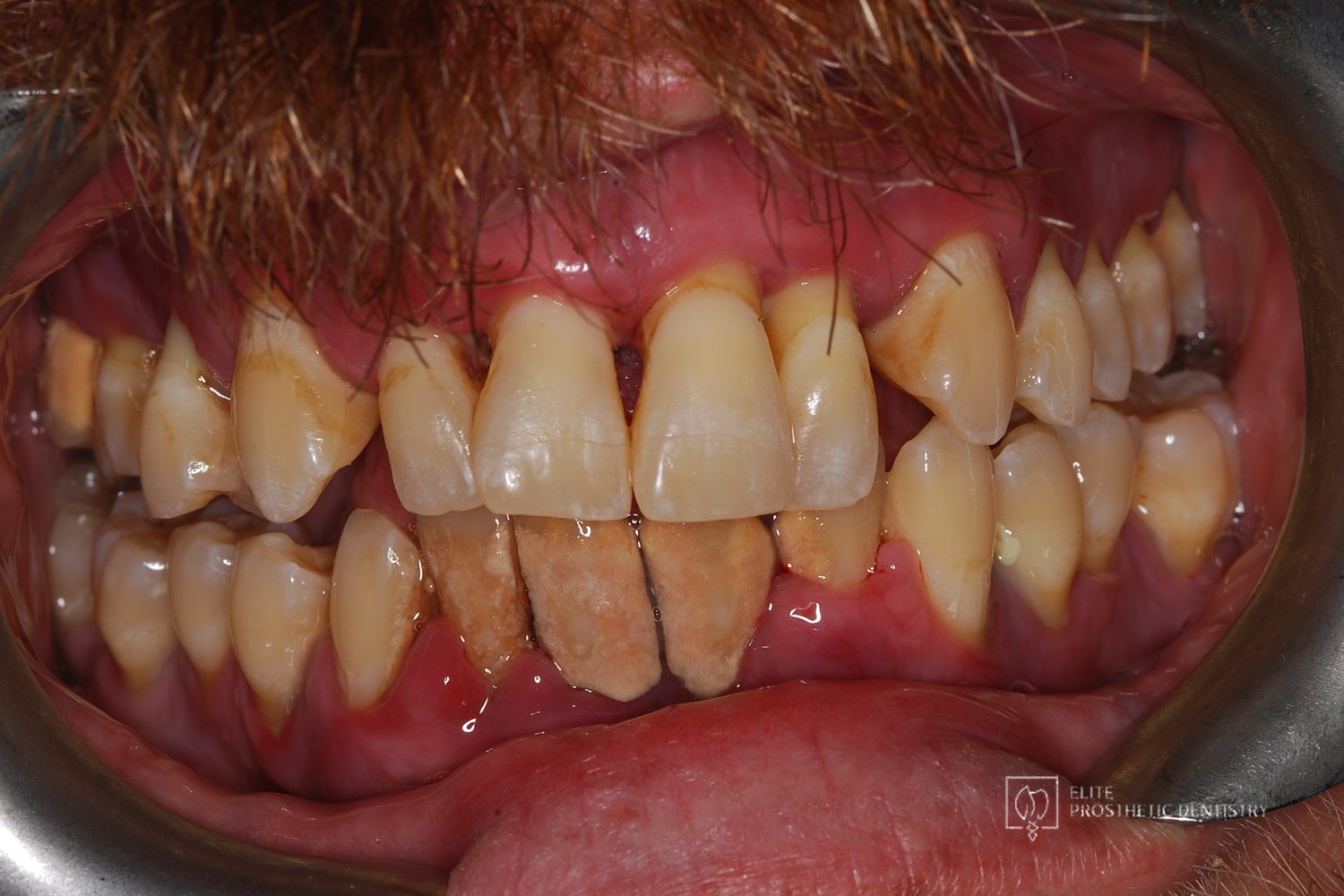
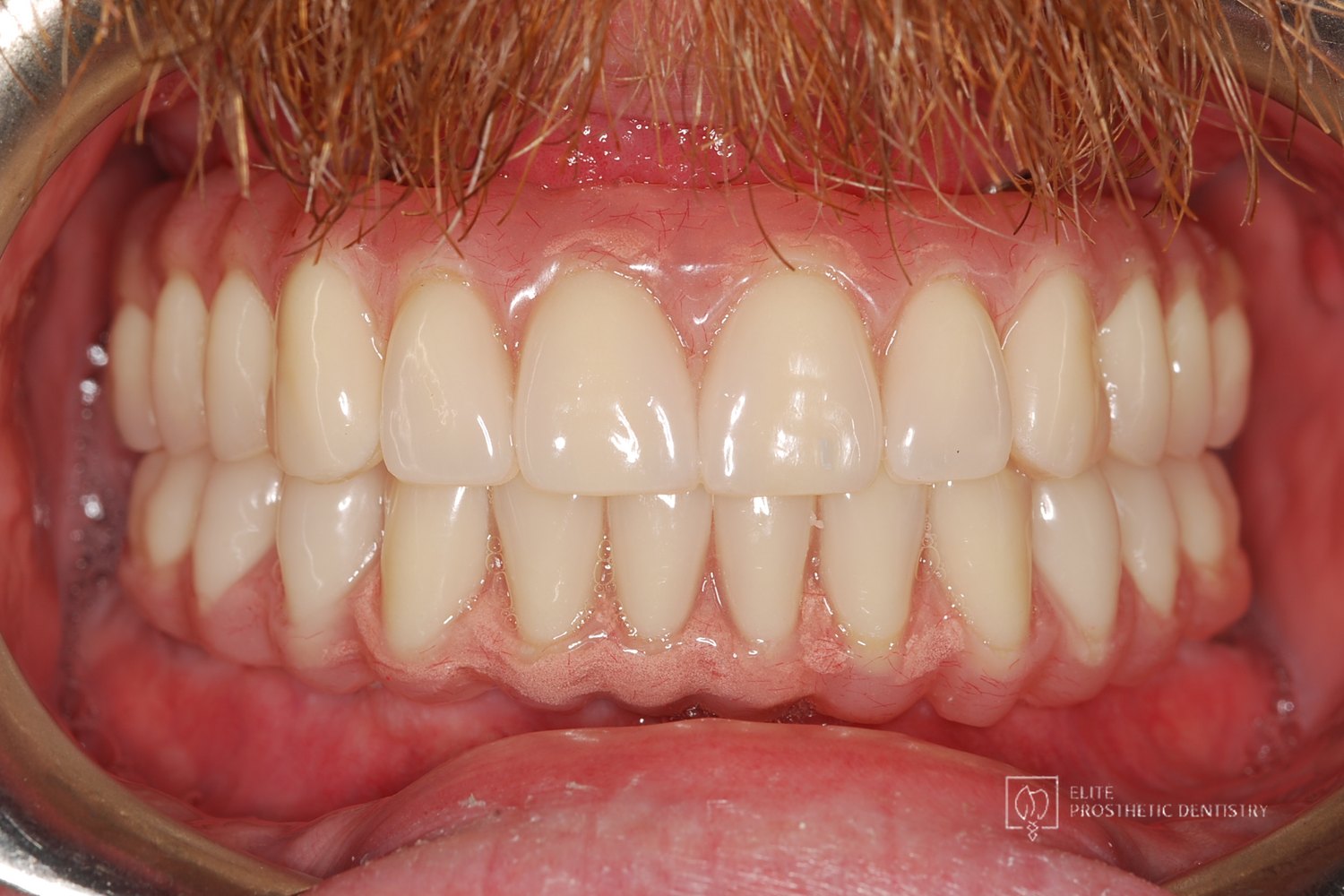
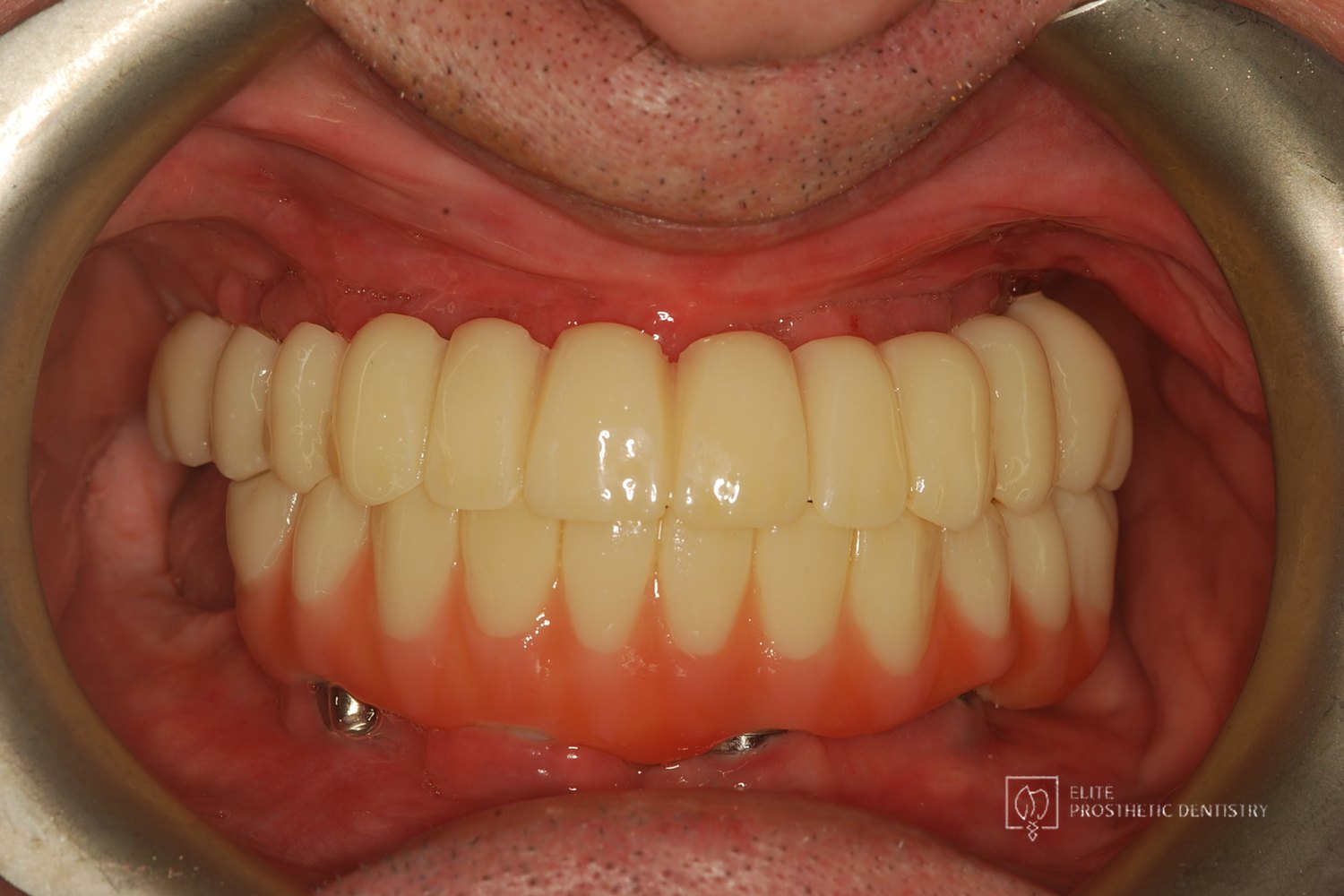
Both Arches Rebuilt After Advanced Periodontal Disease: Twelve Guided Implants and a Signature Hybrid Prosthesis
Advanced periodontal disease had destroyed the support around the remaining teeth in both arches. None could be kept, and the bone that would carry implants had been lost along with them.
 Before
 After
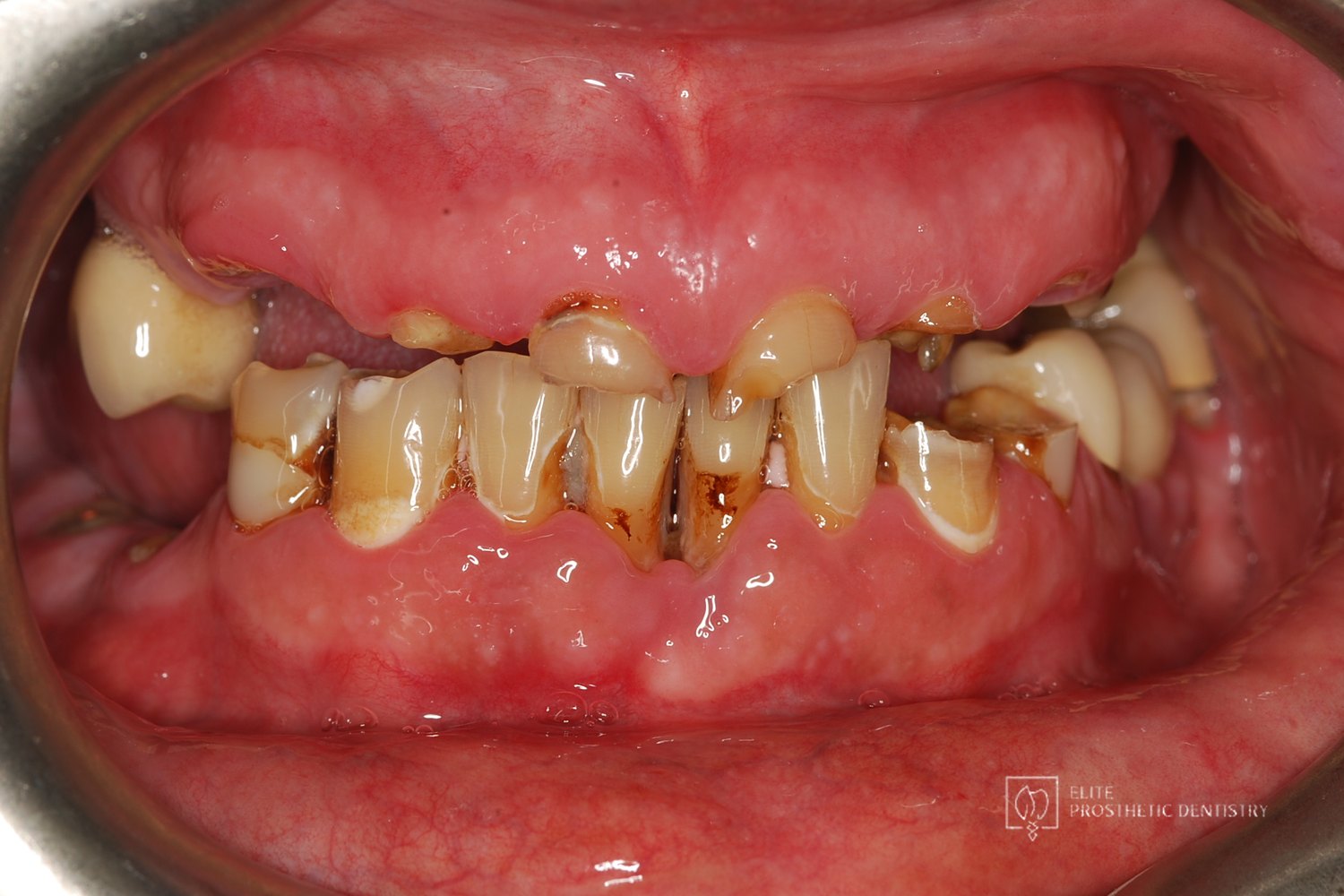
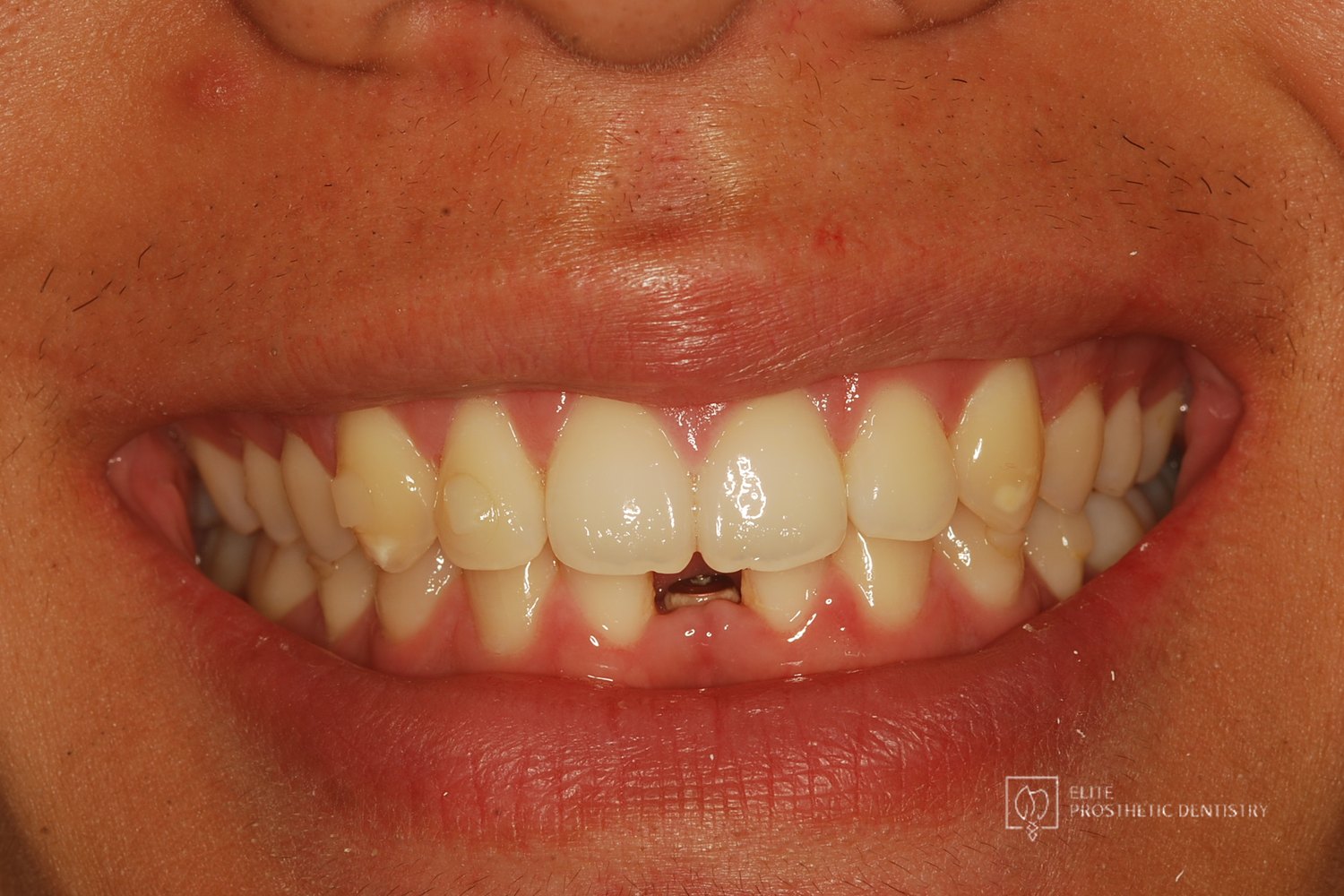
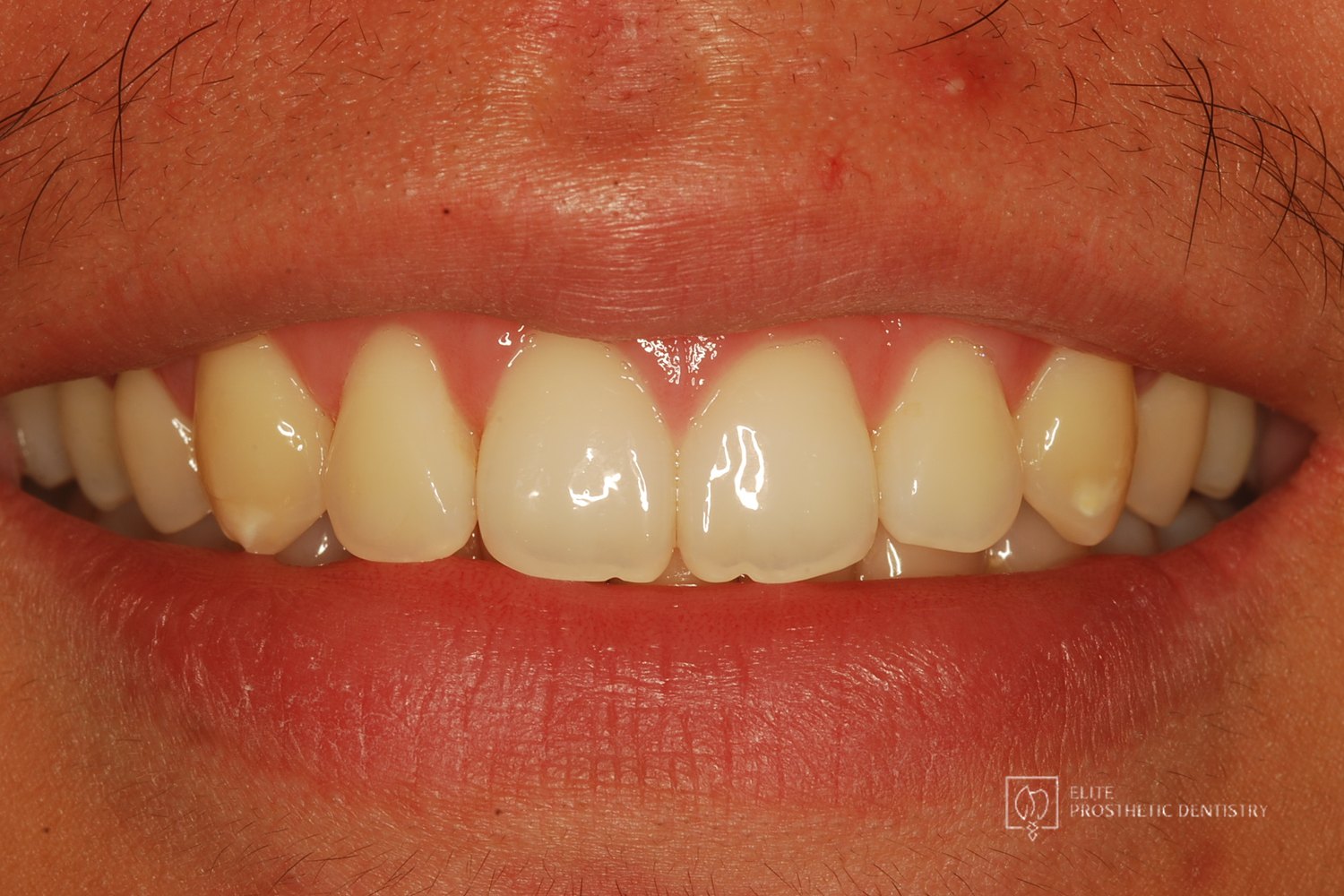
Both Arches Rebuilt After Years Without Dental Care and Heavy Grinding: Eight Guided Implants and an Elite Hybrid Prosthesis
Years without dental care combined with heavy grinding had destroyed the teeth in both arches. None were salvageable, and the bone needed rebuilding before implants could carry a new bite.
 Before
 After
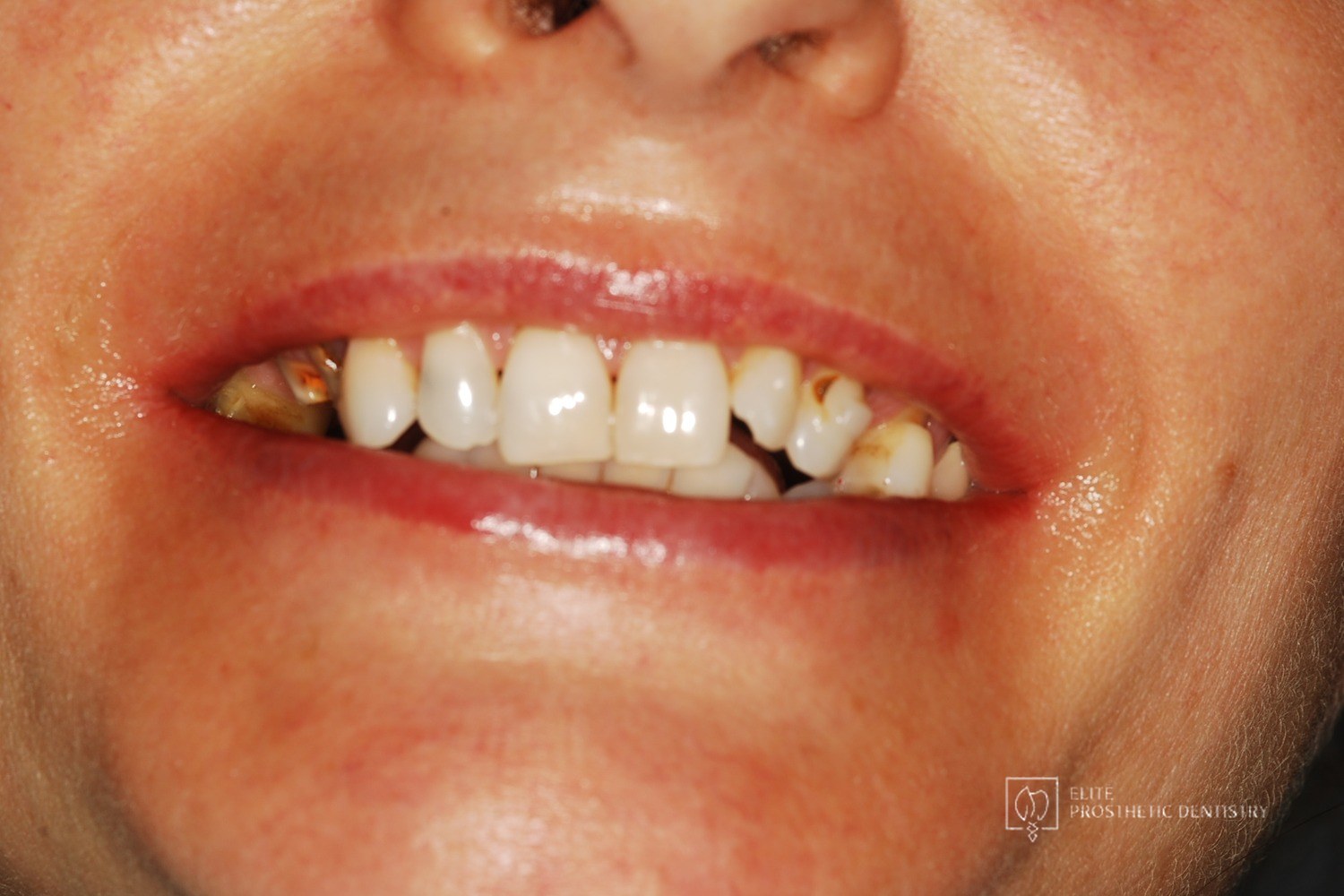
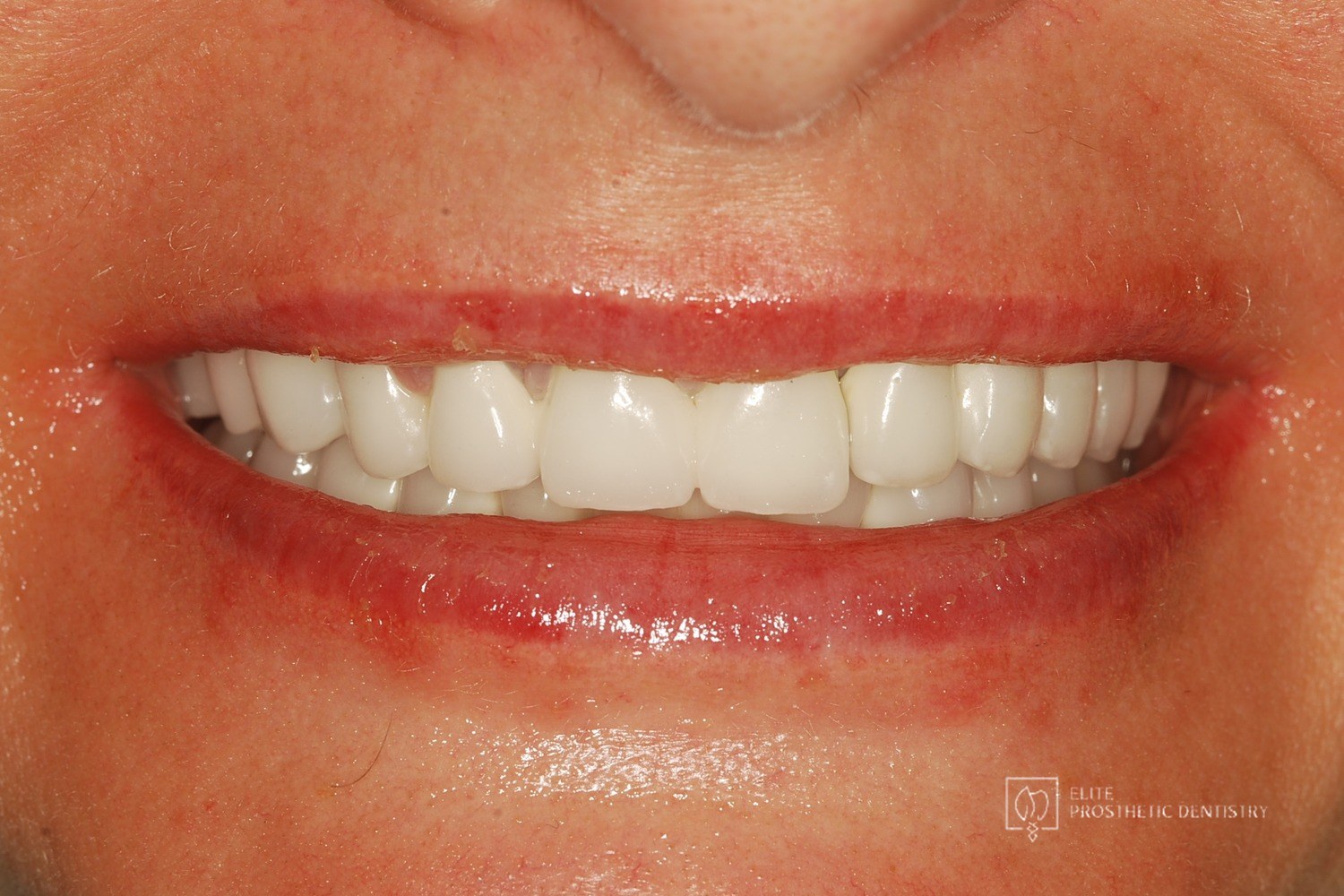
Bone Loss Around a New Dental Implant: Removed Early, the Ridge Rebuilt, and a Guided Replacement Implant Restored
A 26-year-old patient referred for a crown on a recently placed lower front implant arrived with 5 mm pocketing, bone loss, and exposed implant threads around it; a CBCT scan showed a ridge too narrow to hold the implant fully in bone. A crown could have been made, but the foundation would not have lasted.
 Before
 After
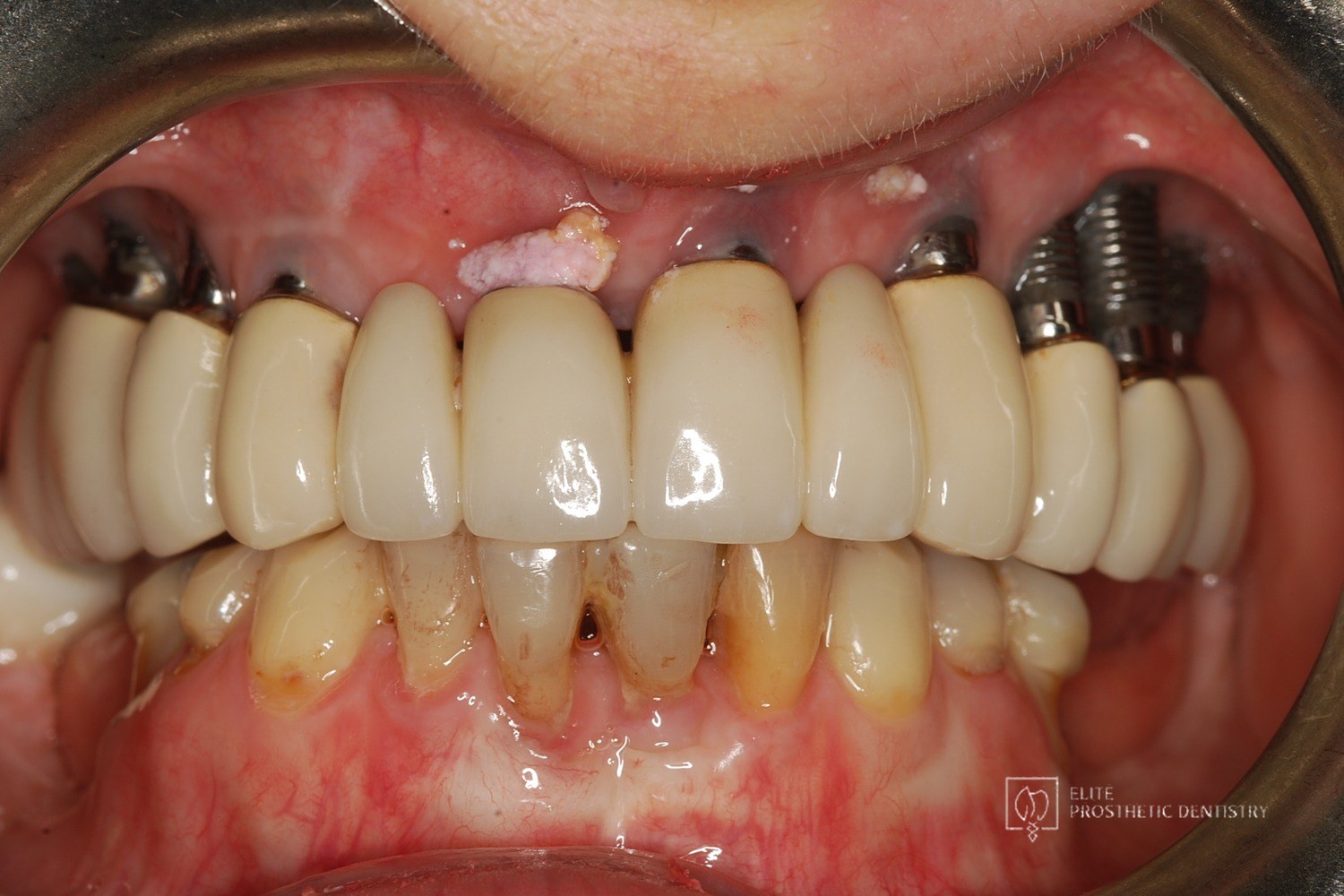
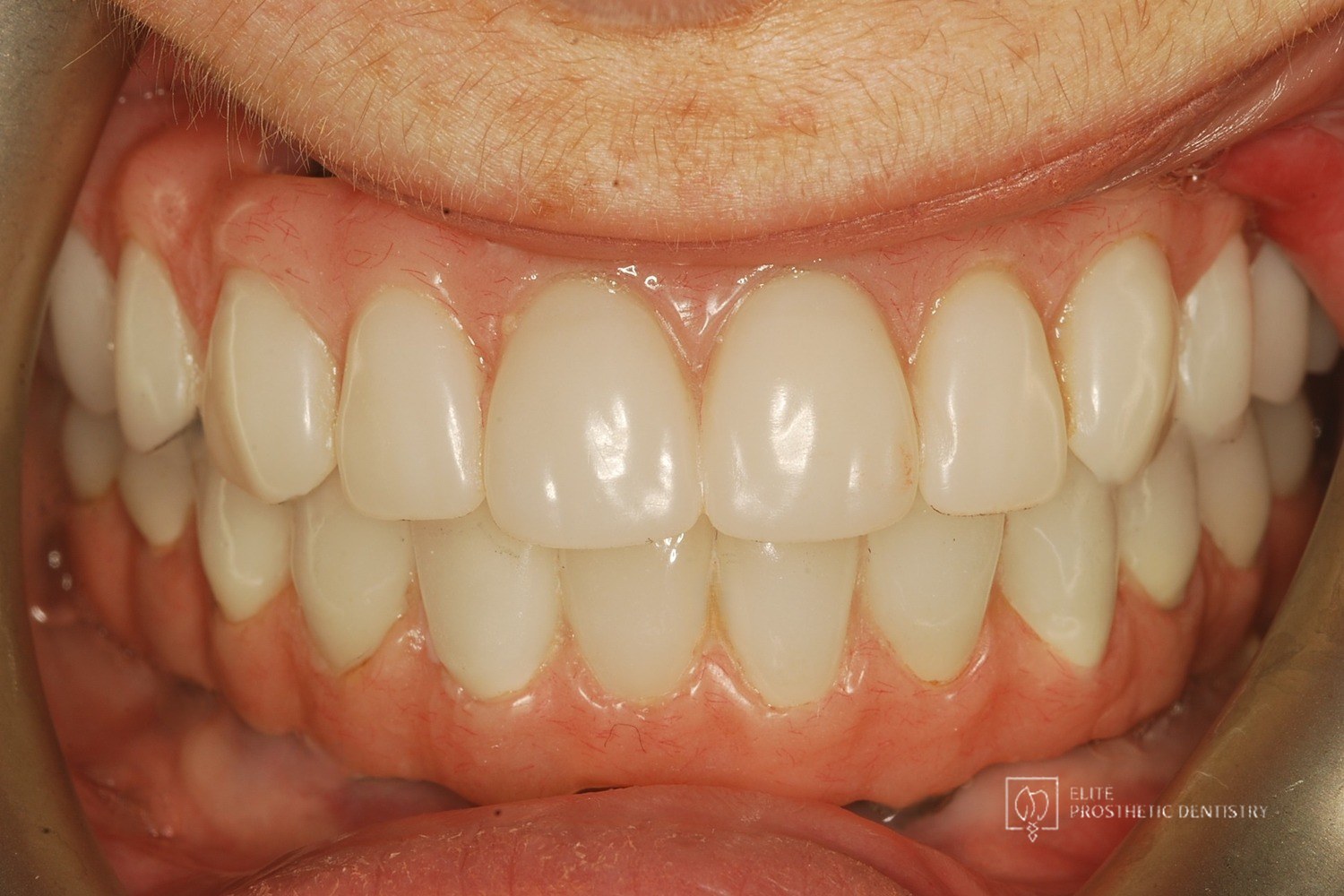
How Aging, Failing Dentistry Was Replaced with a Coordinated Full-Mouth Implant and Crown Reconstruction
The patient presented with throbbing upper-molar pain, long-standing infections, multiple root canals and unfinished prior treatment, generalized sensitivity, and several hopeless teeth.
 Before
 After
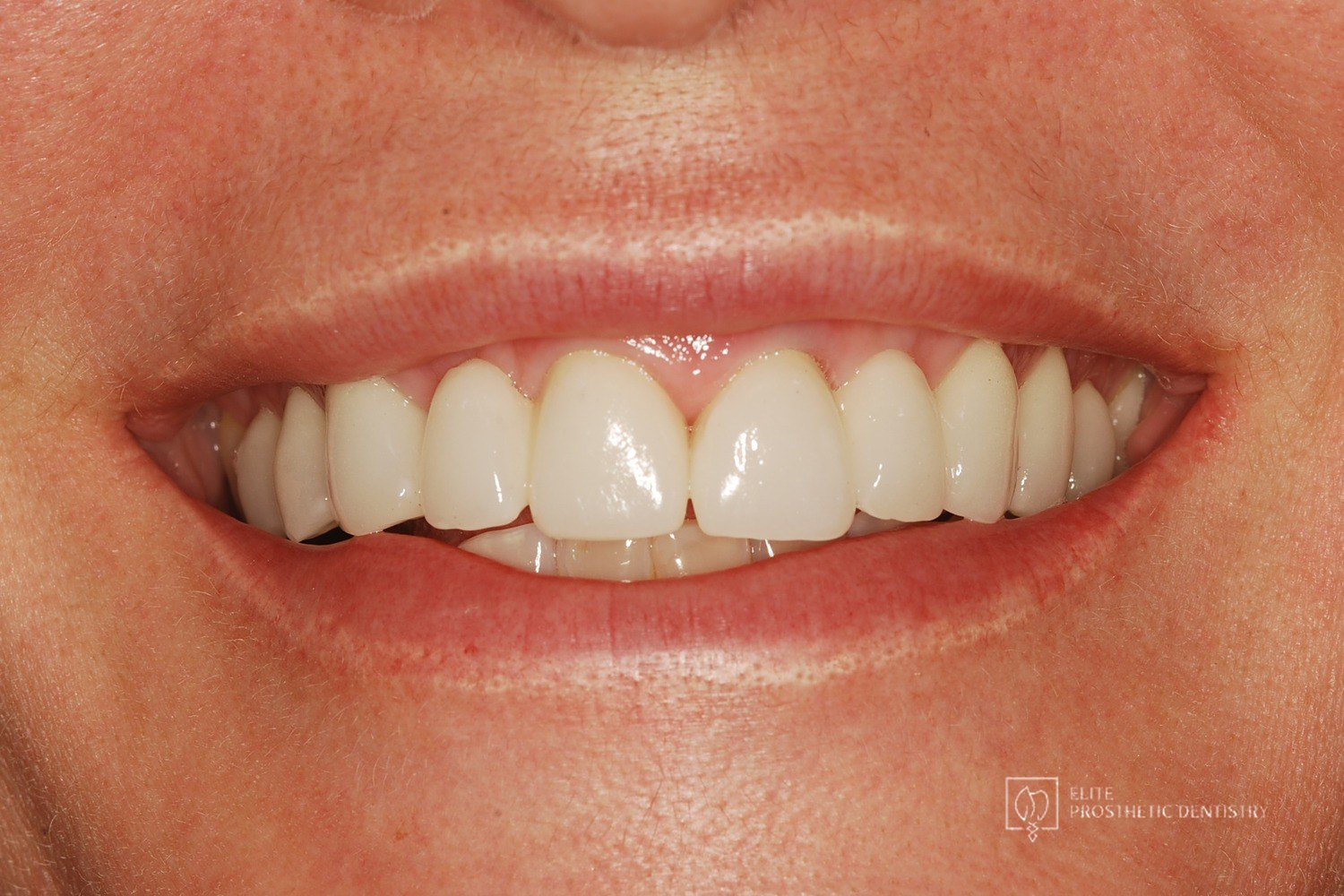
How Failing Implants and Severe Bone Loss Were Rebuilt Into a Stable Full-Arch Implant Reconstruction
The patient presented with significant complications from previously placed implants, severe bone loss, failing posterior implants, and an unesthetic full-arch bridge. Both arches required full reconstruction, with the upper arch showing the most advanced bone loss and instability.
 Before
 After
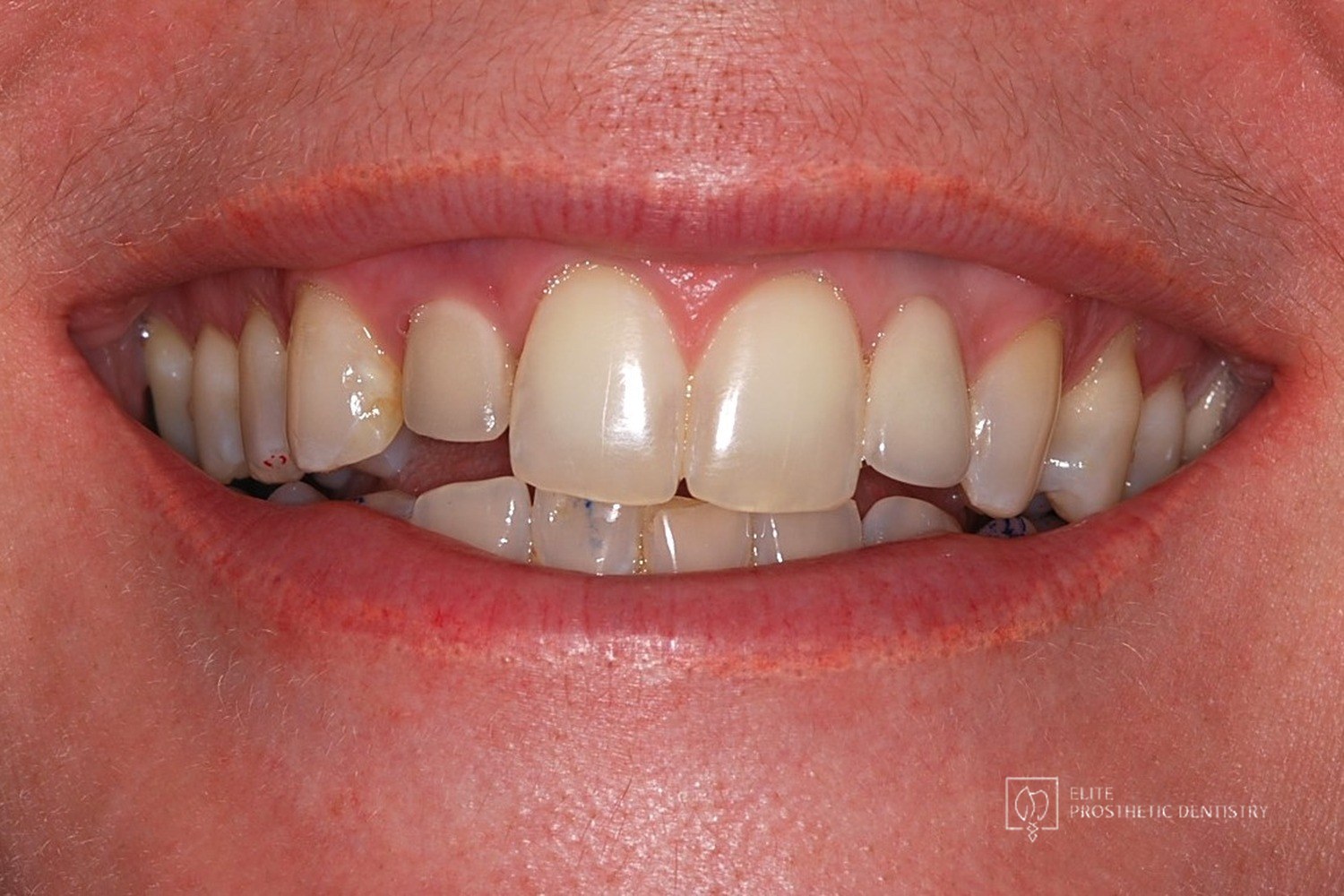
How Failing Lateral Incisor Implants Were Replaced with Custom Zirconia Bridges After Severe Bone Loss Made Replacement Implants Impossible
Comprehensive examination including CBCT imaging revealed significant bone loss surrounding implants that were placed outside the buccal plate, most likely due to placement without a CBCT-generated surgical guide. The implants were determined non-salvageable, and the alveolar ridge was too narrow to support replacement implants without extensive reconstruction.
Related Articles
Deepen your knowledge with additional insights on this topic.
 Dental Implants
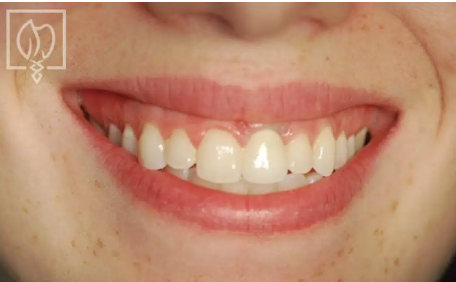
If a Single Front Tooth Is Replaced with an Implant, Can It Look Natural?
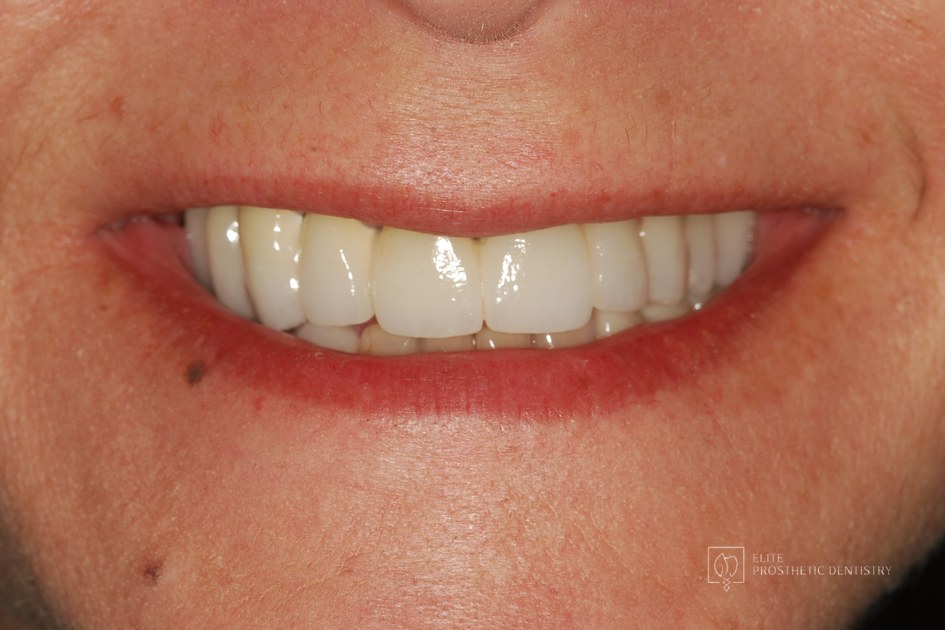
Yes. See the four steps, with real case photos, that make a single front tooth implant indistinguishable from the natural tooth beside it. Washington, DC.
 Dental Implants
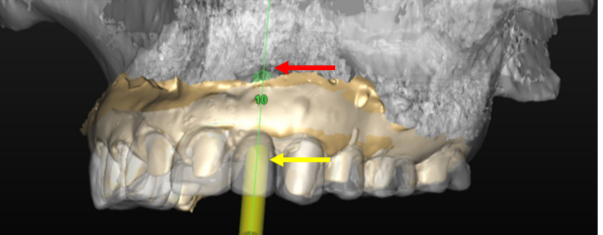
What Is Precision Implant Placement (PIP)?
Precision Implant Placement plans each implant virtually on a CBCT scan, then delivers it with a custom surgical guide. See the three steps with real images.
 Dental Implants
What Is the Ideal Surgical Guide for Precision Implant Placement?
Not all surgical guides are equal. The gold standard is CBCT-based: planned virtually in 3D, 3D printed, and seated on your teeth. A DC prosthodontist explains.
 Dental Implants
When Should an Implant Not Be Done?
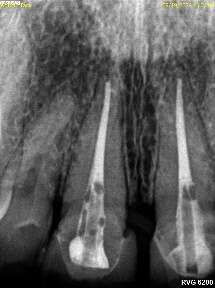
Healthy roots, thin bone, steep bony angles: a DC prosthodontist shows a real case where refusing implants was the right call, and what was done instead.
 Dental Implants
What Is Staged Implant Therapy?
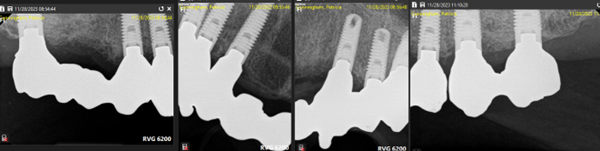
Staged implant therapy replaces failing teeth in phases while you keep fixed teeth the entire time. A DC prosthodontist walks through a real case in stages.
 Dental Implants
The Four Types of Dental Implants: Which One Is Right for You?
Endosteal, subperiosteal, zygomatic, and mini implants each solve a different problem. A DC prosthodontist explains the four types and who each one fits.
Deciding Who Should Treat You?
Our decision guide for McLean patients covers a first missing tooth, a tooth that may need extraction, several missing teeth, full mouth reconstruction and aging crowns and bridges, and when another setting may serve you better.
Read the McLean decision guide →Our Services in McLean
Beyond Dental Implants, McLean patients rely on Dr. Marlin for a full range of advanced dental care.
More services available in McLean:
Dental Implants Near McLean
Dr. Marlin also provides dental implants services for patients in these neighboring communities.
Getting Here from McLean
Elite Prosthetic Dentistry is conveniently located near McLean, VA.
Cross Chain Bridge into DC, continue on Arizona Avenue to our Friendship Heights office. No Beltway needed for most McLean residents.
Address:
4400 Jenifer Street NW, Suite 220
Washington, DC 20015
Phone: (202) 244-2101
Request a ConsultationRequest a Specialist Consultation from McLean
McLean patients come to Dr. Marlin for care that ranges from a first single implant to full-arch and complex reconstruction. With 4,100+ implants placed over 40+ years, planning, surgical placement and restoration are handled in one practice. No referral is needed.