
When Are Fixed Implant Bridges the Best Treatment Option?
Fixed implant bridges combine the technology and security of dental implants with the convenience and aesthetics of a dental bridge replacing one or more teeth.
Unlike a traditional bridge, which uses dental crowns on the teeth adjacent to the gap to support an artificial tooth in between, a fixed implant bridge exclusively relies on dental implants for the prosthesis. This means your natural teeth do not have to be compromised for you to benefit from a fixed implant bridge.
So, when are fixed implant bridges the best treatment option for your smile? Here are a few instances where your prosthodontist may consider a fixed implant bridge over a traditional one.
There Are No Remaining Teeth to Anchor the Bridge
Patients who lack teeth in a section of their mouth requiring a prosthesis to replace them would benefit from an implant-supported bridge, since teeth are lacking for the support. When adjacent teeth are absent, a traditional bridge is not feasible, unless more teeth are crowned.
By placing two dental implants, the patient can have a fixed bridge that provides more security and bone preservation than a traditional bridge, since the titanium implant fosters bone integrity. Two dental implants on either side of the gap would support one or more artificial teeth in between, allowing the patient to have a row of natural-looking teeth over the gap.
There Are Multiple Missing Teeth in a Row
When a patient has multiple missing teeth in a row, an implant-support bridge is an excellent option. Even if a patient has adjacent teeth a few spots away, a fixed implant bridge will provide additional stability and security for patients with large gaps of missing teeth.
As stated, by using a fixed implant bridge in such cases, the patient can avoid compromising the neighboring teeth and instead have a fixed, secure, and aesthetically pleasing bridge to replace the missing teeth [1].
The Adjacent Teeth Are Not Healthy
A traditional bridge requires the neighboring teeth to be healthy to support the dental crowns that will ultimately support the bridge. However, if the teeth adjacent to the gap are not healthy or have already been restored, a fixed implant bridge will likely be the better option.
Adjacent teeth that are too weak to support a bridge may make a fixed implant bridge a more appropriate treatment option. This way, the neighboring teeth can remain undisturbed while dental implants provide a durable tooth restoration.
If the adjacent teeth are already healthy, an implant-supported bridge eliminates the need to reshape these teeth and remove tooth enamel to place dental crowns as a support. Therefore, the patient can retain these healthy teeth and have a natural-looking prosthesis in the form of a fixed implant bridge [2].
There Are No Remaining Upper or Lower Teeth
In cases where the patient is missing their entire upper or lower row of teeth, Dr. Marlin can place several implants to support either a fixed bridge or a screw retained prosthesis known as All-on-4-type implant therapy. In this treatment, the dental implants support a large, fixed appliance as the prosthesis.
The benefits of this type of treatment approach are numerous. The patient will still receive all the benefits of dental implants, such as a natural-looking smile, a secure restoration, and bone preservation of the jaw, but without needing dentures or a dental implant for every single tooth [3].
When You Want an Effective Long-Term Teeth Replacement Option
Dental bridges can last for a decade with proper care [4]. However, an implant-supported bridge has the potential to last much longer.
When you work with Elite Prosthetic Dentistry for your fixed implant bridge, our experienced prosthodontists Dr. Marlin use Precision Implant Placement (PIP) and custom-made crowns to create a prosthesis that is beautiful, comfortable, and has the maximum potential to last as long as possible.
Fixed implant bridges are ideal for patients who don’t want to replace a traditional dental bridge every decade or a partial denture every few years.
Find Out If You Qualify for a Fixed Implant Bridge
Contact Elite Prosthetic Dentistry today to schedule a consultation and find out if you qualify for a fixed implant bridge. Our experienced prosthodontists will fully evaluate your smile and explore all your treatment options with you so you can make the best decision for your restorative care.
Sources:
Related Case Studies
Explore similar cases demonstrating our expertise in advanced prosthetic dentistry.
 Complex
 Temporary Crowns Restore Patient's Smile in Just One Day with an Immediate Smile Makeover
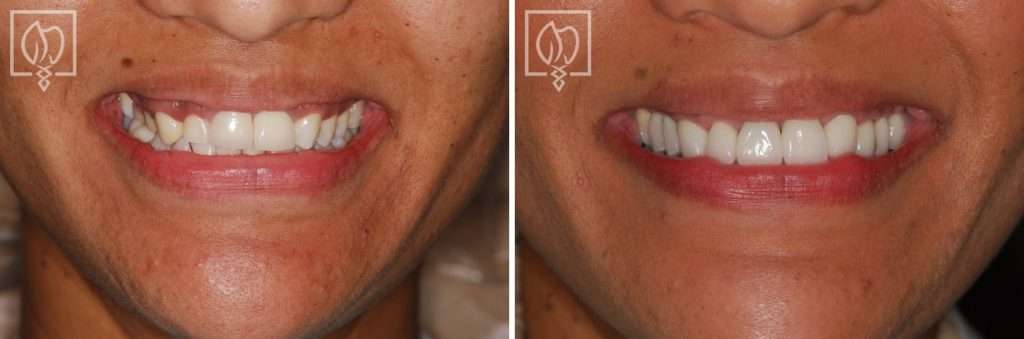
Her dental implant looked artificial in her mouth and was impacting her smile. She had been very unhappy with her unsightly smile line and was beco...
 Complex
 Multi-Faceted Treatment for Patient Unhappy With Her Artificial-Looking Crowns, Teeth and Gums
Many patients come to Elite Prosthetic Dentistry unhappy with the appearance of their smile. A particular patient who sought our help was very unha...
 Standard
 Treating Kevin’s Collapsed Bite with a Complete Smile Makeover with New Dentures
Kevin came to us very dissatisfied with his existing condition. He looked much older than his age because his bite was collapsed and no one could r...
Related Articles
Deepen your knowledge with additional insights on this topic.
Rejuvenating a Ruined Implant Site Having Severely Damaged Bone
Even after a failed implant and significant bone loss, it is often possible to rebuild the ridge and restore a healthy foundation for a new implant.
If a Single Front Tooth is Replaced with an Implant, can it Look Natural?
A single front tooth implant can look completely natural with precision placement, custom abutments, and hand-crafted porcelain crowns. Washington, DC.
What is Precision Implant Placement (PIP)?
Learn what Precision Implant Placement (PIP) is and how meticulous planning ensures optimal implant positioning for long-lasting results in Washington, DC.