
Can a Failing Dental Implant Be Saved or Repaired?
Dental implants are an excellent investment in your smile that can mimic the appearance, function, and durability of your natural teeth. When properly placed and cared for, dental implants can last for decades.
However, not every dental implant lasts (please see our previous blog, “Common Factors That Can Limit the Success of Dental Implants”). There are many reasons a patient may have an implant that is failing. A failing dental implant may cause pain, gum recession, difficulty chewing, or swelling around the restoration.
Can a failing dental implant be saved or repaired? We will help you understand your treatment options for a failing dental implant, below.
The Bone Supporting the Implant May Need to Be Repaired
A bone graft can help restore the supportive tissue around the implant to save the restoration [1]. While you may not need to have your dental implant removed for a bone graft, in some cases, the implant will need to be replaced with a new one following bone augmentation.
By augmenting the bone around the implant, Dr. Marlin can save your implant to ensure a secure and beautiful restoration.
You May Need Treatment for Gum Disease
Periodontal disease, also called gum disease, can cause inflammation and infection around a dental implant (called peri-mucositis) as well as bone loss (called peri-implantitis) that can cause the implant to fail [2].
If you have gum disease that is causing a failing implant, treatment is necessary to help repair the implant site. In severe cases, the implant may need to be removed and replaced. However, mild to moderate cases of periodontal disease may only need minimal intervention in order to restore the health of the implant. In most instances, Dr. Marlin at Elite Prosthetic Dentistry can remove the abutment and crown, decontaminate the implant, and repair the implant with a bone graft.
Having your teeth professionally cleaned every six months and maintaining good oral health at home can help prevent gum disease and keep your implant healthy.
The Dental Implant May Need to Be Repositioned
If your dental implant was not properly placed to begin with, the implant may eventually fail. Improper placement can result in aesthetic and functional complications that can make a successful implant outcome impossible without correcting the placement issue [3].
Dental implants that fail due to improper positioning can typically be saved. Dr. Marlin meticulously plan your dental implant rehabilitation on a CBCT (3D image) prior to implant placement followed by Precision Implant Planning (PIP), which allows them to prevent this from happening and consistently achieve a successful outcome.
Precision-placed implants have a higher success rate, which is what allows Elite Prosthetic Dentistry to have a dental implant success rate higher than the national average.
If Your Implant Has Not Healed Properly
The healing stage for your initial implant placement is crucial to the success and longevity of your restoration. While proper placement is paramount, it’s equally important that you take good care of your smile after the implant placement process.
An implant may not heal properly due to improper placement, putting too much pressure on the teeth too soon (as is commonly seen in patients with bruxism), and not having enough bone to initially support the implant [4].
No matter why your dental implant is failing, we can help you address the root cause of your implant failure and discuss treatment options.
Is Your Dental Implant Failing?
If you are concerned that your dental implant is failing or are seeing signs of implant failure, don’t wait to speak to an experienced prosthodontist about your smile restoration. Contact Elite Prosthetic Dentistry today to schedule a consultation with Dr. Marlin to discuss your smile rehabilitation.
Sources:
Related Case Studies
Explore similar cases demonstrating our expertise in advanced prosthetic dentistry.
 Complex
 Temporary Crowns Restore Patient's Smile in Just One Day with an Immediate Smile Makeover
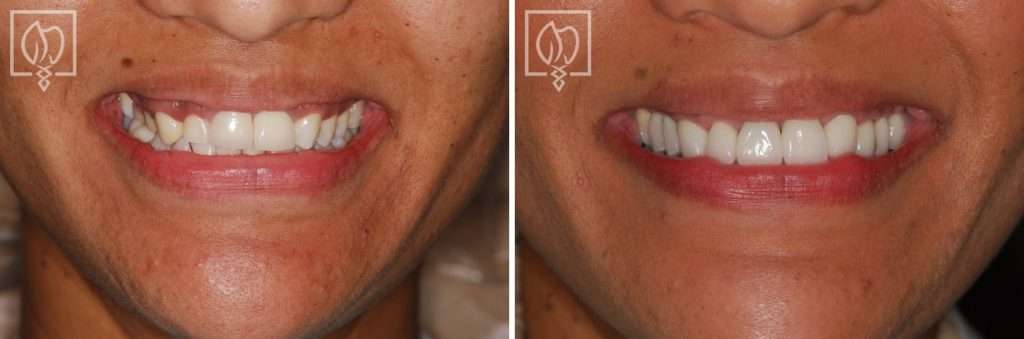
Her dental implant looked artificial in her mouth and was impacting her smile. She had been very unhappy with her unsightly smile line and was beco...
 Complex
 Multi-Faceted Treatment for Patient Unhappy With Her Artificial-Looking Crowns, Teeth and Gums
Many patients come to Elite Prosthetic Dentistry unhappy with the appearance of their smile. A particular patient who sought our help was very unha...
 Standard
 Treating Kevin’s Collapsed Bite with a Complete Smile Makeover with New Dentures
Kevin came to us very dissatisfied with his existing condition. He looked much older than his age because his bite was collapsed and no one could r...
Related Articles
Deepen your knowledge with additional insights on this topic.
Rejuvenating a Ruined Implant Site Having Severely Damaged Bone
Even after a failed implant and significant bone loss, it is often possible to rebuild the ridge and restore a healthy foundation for a new implant.
If a Single Front Tooth is Replaced with an Implant, can it Look Natural?
A single front tooth implant can look completely natural with precision placement, custom abutments, and hand-crafted porcelain crowns. Washington, DC.
What is Precision Implant Placement (PIP)?
Learn what Precision Implant Placement (PIP) is and how meticulous planning ensures optimal implant positioning for long-lasting results in Washington, DC.